 NEWS
NEWS
New works by a renowned sculptor
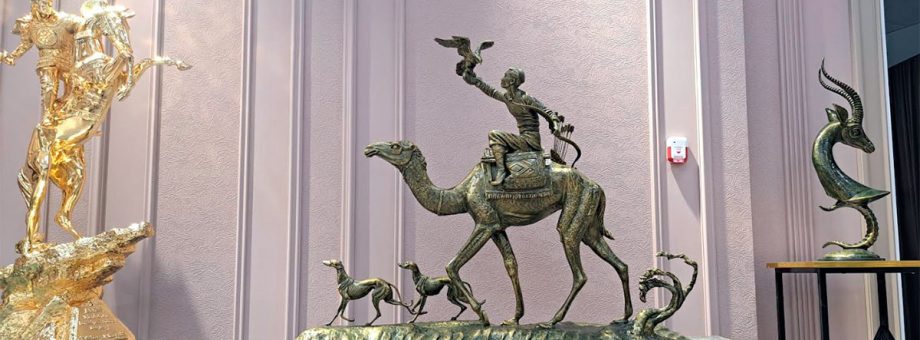
The traditions of Turkmen hunting, including falconry, are reflected in a new work by the renowned sculptor, member of the Union of Artists of Turkmenistan, Baygeldi Annamedov, titled “Düýäniň üstündäki awçy”. The artist depicts a Turkmen youth hunting while riding a camel. In one hand he holds a bow, and on the other, raised upward, sits a hunting falcon. The hunter is accompanied by a pair of Turkmen sighthounds-tazy, and the action takes place amid the sands.
As is well known, hunting was widespread among the Turkmens everywhere. It was considered a truly masculine occupation that developed quick reaction, dexterity, accuracy, endurance, and patience. Foreigners who visited these lands in ancient times noted that Turkmens never went even on a falconry hunt without a bow and arrows, as they were skilled archers, accurately hitting their targets both on horseback and on foot. Indispensable assistants, especially in mounted hunting, were the tazy—representatives of an ancient breed of hunting dogs capable of quickly detecting and overtaking game.
As always, Baygeldi Annamedov’s ability to realistically convey sensations of movement, energy, and tension in his works is striking. A skillfully selected color palette and meticulous elaboration of small elements have made the polyester sculpture three-dimensional, realistic, and expressive.
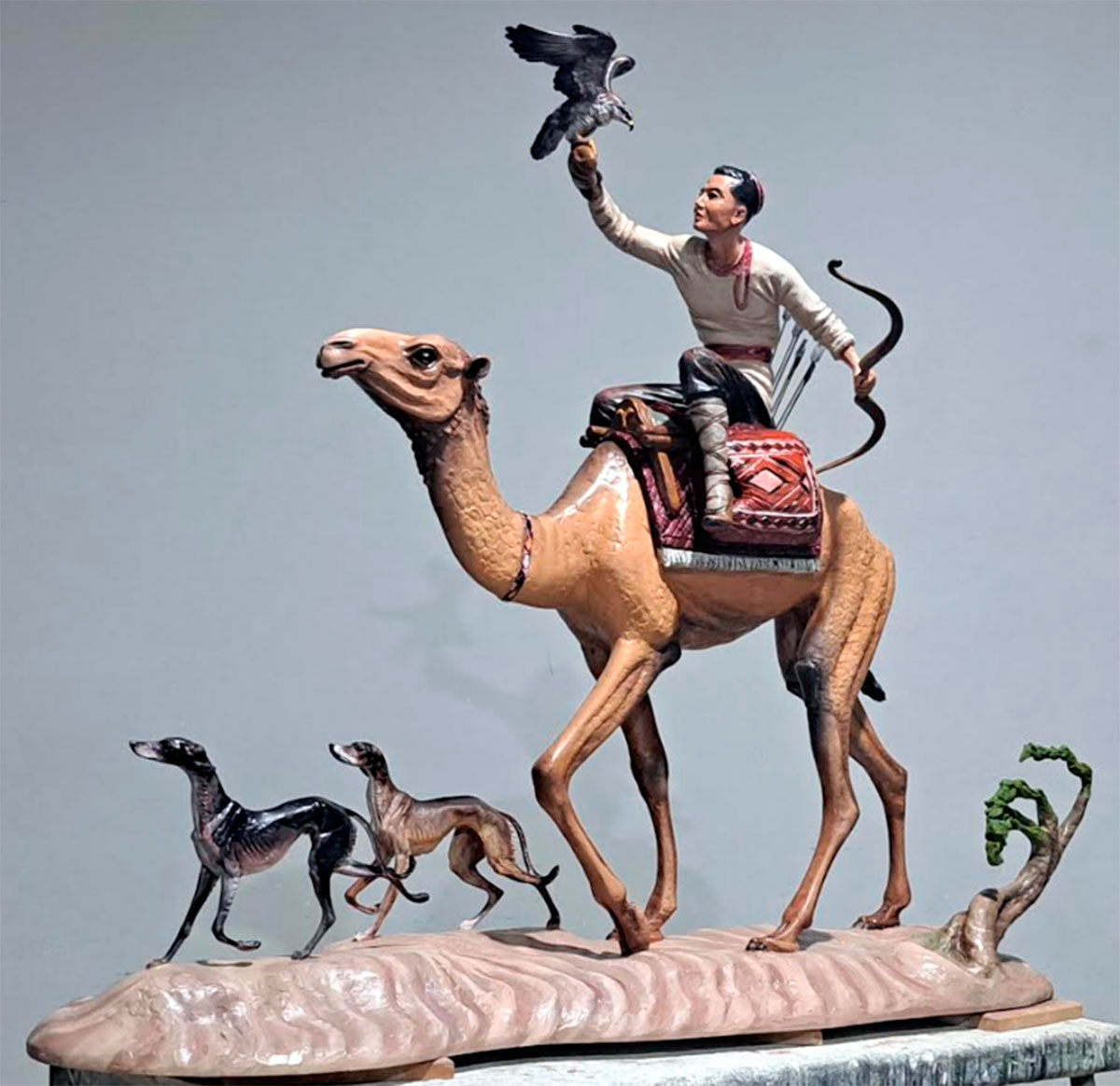
One can sense that the author devoted great attention to detail. Even the “background” figures—the tazy running alongside the camel—are sculpted successfully and convincingly: dogs of graceful build with fine coats, long muzzles, and very expressive eyes.
A viewer who has the opportunity to examine the sculpture from all sides and appreciate it in space will undoubtedly note the realism of this new work, which was first presented at the artist’s solo exhibition in the capital of the country.
Another work by Baygeldi Annamedov, titled “Jelalledin Menburun, horezmşa soltany”, is equally impressive in its ability to fully convey the drama and emotional intensity of the situation, to accurately and truthfully reproduce reality. This work was first shown to visitors at the end of last year at an exhibition in the Historical and Local Lore Museum of Dashoguz velayat.
The last Khorezmshah is depicted mounted on a warhorse, with a bare saber in his hands, at the moment of a fierce battle. His face expresses determination and readiness to strike the enemy with a swift blow. The sultan’s battle armor is detailed down to the smallest elements—chain mail, helmet, cloak, breastplates, and shoulder guards—as well as the protective combat gear of the rearing steed.
The sculpture reflects the spirit of the era and the personality of the legendary warrior-ruler, emphasizing his valor and strength.